How to Organize Your Home Supply Cabinet
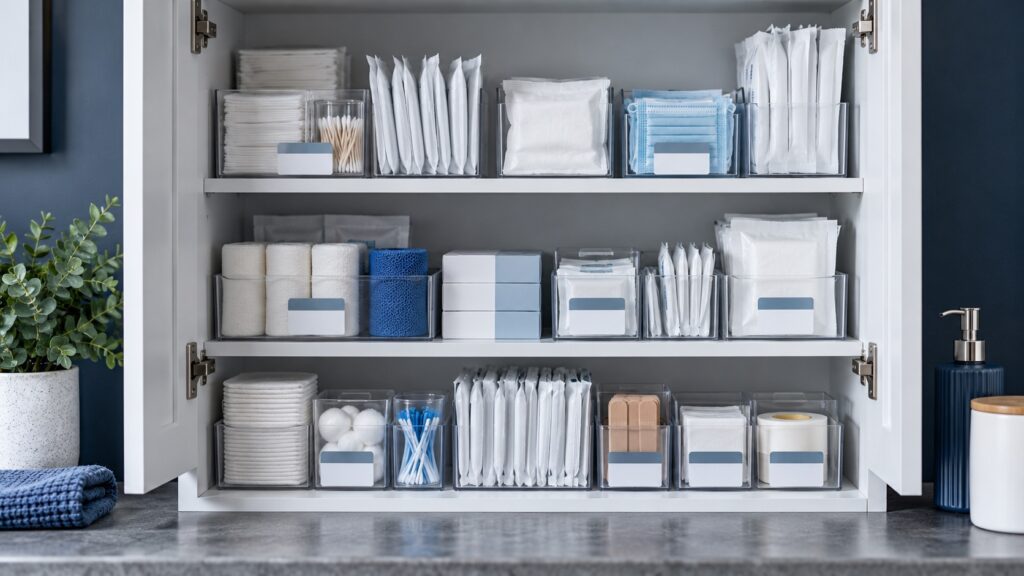
A useful supply cabinet makes three things easy to see: what you have, what each item is, and what needs attention before the next order. It does not need matching containers or a large shelving system. Clear labels and a short inventory often do more than an elaborate arrangement that is difficult to maintain.
The workflow below is for organising unused household supplies. Keep used sharps and waste in their designated disposal system. If you store medicines or supplements nearby, their individual storage directions take priority over general organising advice.
Choose the location around the labels
Read storage instructions before choosing a cabinet. A tidy location is only useful if it meets the products’ requirements. Health Canada advises attention to proper medication storage, including protection from heat and sunlight; individual product instructions still govern any special conditions. Source: Health Canada storage guidance.
Look at the space as it is used throughout the day. Can you read the labels without taking everything out? Will boxes be crushed when the door closes? Is the location appropriately secured from children and pets? Choose access and visibility over a display that only looks neat in a photograph.
Keep identification with the product
Retain packaging that carries the product name, reference number, lot, expiry date and instructions. An attractive unlabelled jar can make reordering harder because it separates the contents from useful information. Keep individual sterile packages intact until their intended use.
If an outer box is too large for the space, consider a larger suitable organiser rather than automatically removing labels. Where you use a bin to group packages, label the bin as an aid while keeping the original product identification with the stock. Avoid mixing similar-looking sizes in one unlabelled compartment.
A photo of the package can be useful for shopping, but it should supplement the physical label rather than become the only place that essential information exists.
Group by product type and exact size
Start with broad groups such as gloves, prep supplies, dressings and unused storage accessories. Within each group, separate sizes or specifications that could be confused. For example, two different glove sizes need separate labelled spaces even if the boxes share the same design.
| Area | What belongs there | Label to add |
|---|---|---|
| Current stock | Identified, usable unopened supplies | Product name and exact size |
| Reserve stock | Extra sealed packs | Pack count and location |
| Check before use | Items with unresolved damage or expiry questions | Reason they are set aside |
| Records | Order notes and product references | Date last checked |
The “check” area is not a way to extend an expiry date or make damaged items usable. It simply prevents a questionable item from being mixed back into normal stock while you obtain advice or arrange appropriate disposal.
Make a small inventory you will actually maintain
Use a note, spreadsheet or paper list with five columns: product, specification, unopened quantity, expiry if applicable, and question or reorder note. Count packs consistently. If you switch between boxes and individual items without labelling the unit, the list becomes misleading.
For example, write “2 unopened boxes × 100” rather than “2.” Record an opened pack separately if its remaining count matters to your planning. The goal is a reliable shopping picture, not a complicated stock-control system.
Set a review routine that fits your household, such as checking before each order. Review dates and packaging condition, then put stock with the earliest applicable expiry where it can be identified easily. Follow the label; older stock is not automatically suitable merely because it is at the front.
Receive new orders using the same routine
- Match each item to the order: name, reference, size and pack count.
- Inspect packaging before mixing the delivery with existing stock.
- Read any updated instructions or changes to the label.
- Add the quantity and relevant dates to your list.
- Place it in the labelled space and keep the order reference.
If an item differs from what you expected, photograph its packaging and contact the seller. Resolve the difference before treating it as an equivalent replacement.
Keep unused supplies and disposal separate
A pouch, drawer divider or plastic storage bin is not a sharps container. Plan the disposal route independently using the sharps-container guide. Do not place used equipment back with unopened stock.
For your next order, turn the inventory into a clear shopping list. Browse Storage & travel only after measuring the space and identifying what needs organising; the container should fit the system you need.
Prepared by Anabolic RX. Sources checked October 17, 2026. Product labels and local programme details may change; check the current information for the exact item.