Reading Supplement Labels: A Canadian Shopping Guide
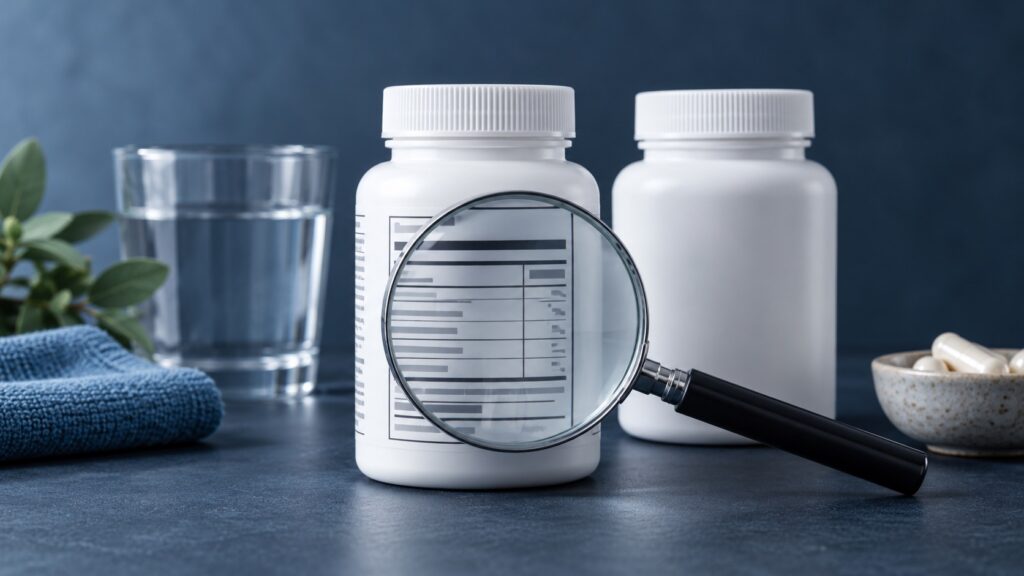
A supplement’s front label is designed to be noticed quickly. The information needed for a useful comparison is usually spread across the ingredients, directions, warnings and package count. Two bottles with a similar headline number can contain different formulations or describe the amount in different ways.
This guide explains how to read those details as a shopper in Canada. It does not recommend a supplement or dose. A pharmacist or other qualified healthcare professional can help with questions about suitability, interactions or use alongside medicines.
Identify the exact product and licence information
Health Canada’s Licensed Natural Health Products Database lets you look up licensed products by details including their Natural Product Number. An NPN is an eight-digit identifier. A record can include the product name, licence holder, medicinal and non-medicinal ingredients, recommended use and risk information. Match the record to the actual product rather than relying on an ingredient name alone. Source: Health Canada’s database guide.
Write down the brand, full product name, formulation and product number before comparing another bottle. A number associated with one formulation does not establish the status of every product sharing the same ingredient or brand. If a listing does not provide enough information to identify the product, ask for the complete label.
Separate amount per unit from bottle count
“Amount per capsule,” “amount per serving” and “capsules per bottle” answer different questions. Health Canada’s labelling guidance identifies medicinal-ingredient quantities per dosage unit, directions and net quantity as distinct pieces of information. Read the wording beside a number, not only the number itself. Source: Health Canada labelling guidance.
For a fictional arithmetic example, a bottle of 60 capsules with a label referring to two capsules per serving contains 30 such servings. That calculation explains the count; it is not a recommendation to take two capsules. Follow the actual product’s directions and professional advice.
A bottle count cannot tell you how long the product should be used, and a higher ingredient amount is not automatically a better choice. Keep the recommended use, warnings and any duration information beside your comparison.
| Field | What to record |
|---|---|
| Identity | Brand, exact name, formulation and NPN where applicable |
| Medicinal ingredients | Names and labelled amounts per dosage unit |
| Other ingredients | Non-medicinal ingredients and relevant allergen information |
| Directions and warnings | The complete label, including any insert |
| Quantity | Capsules, tablets or measured volume per package |
| Traceability | Lot, expiry and manufacturer contact details |
Read ingredients and warnings before price
Do not stop after finding the ingredient you recognise. Read the other ingredients and any accompanying warnings too. If the page shows only the front of a bottle, request a clear image of the remaining panels or the manufacturer’s complete product information.
Health Canada’s guidance includes recommended use, dose, risk information, lot number and expiry among label details. Those fields help you understand what the product claims and the conditions attached to that claim. They should not be replaced by a retailer’s short promotional description. Health Canada label details.
If you need professional advice, bring the exact label and a current list of medicines and supplements to your pharmacist or clinician. A general product name may not identify the formulation they need to assess. Avoid sending sensitive medical histories through ordinary store support messages.
Make a fair price comparison
After establishing that the products you are comparing are appropriate, calculate price per capsule or other clearly defined unit. Use that figure to compare like-for-like packages, not to rank different formulations by strength.
For example, a fictional 60-capsule bottle at $24 costs $0.40 per capsule; a 90-capsule bottle at $33 costs about $0.37 per capsule. Those numbers only describe package economics. They do not establish equivalent ingredients, quality, benefit or suitability.
For larger packs, check available storage space and expiry information before ordering. Our pack-size guide explains how shipping changes an order-level comparison.
A final label checklist
- I can identify the exact product and formulation.
- I have checked the relevant Canadian licence record where applicable.
- I understand whether amounts refer to a capsule, another dosage unit or a serving.
- I have read the complete directions, ingredients and warnings.
- I have resolved suitability questions with a qualified professional.
- I know the bottle count and have reviewed expiry and storage details.
Use the Supplements category to find product information, and ask for missing label details before purchasing. A clear, complete label is a better starting point than a dramatic front-of-bottle claim.
Prepared by Anabolic RX. Sources checked October 17, 2026. Product labels and local programme details may change; check the current information for the exact item.